
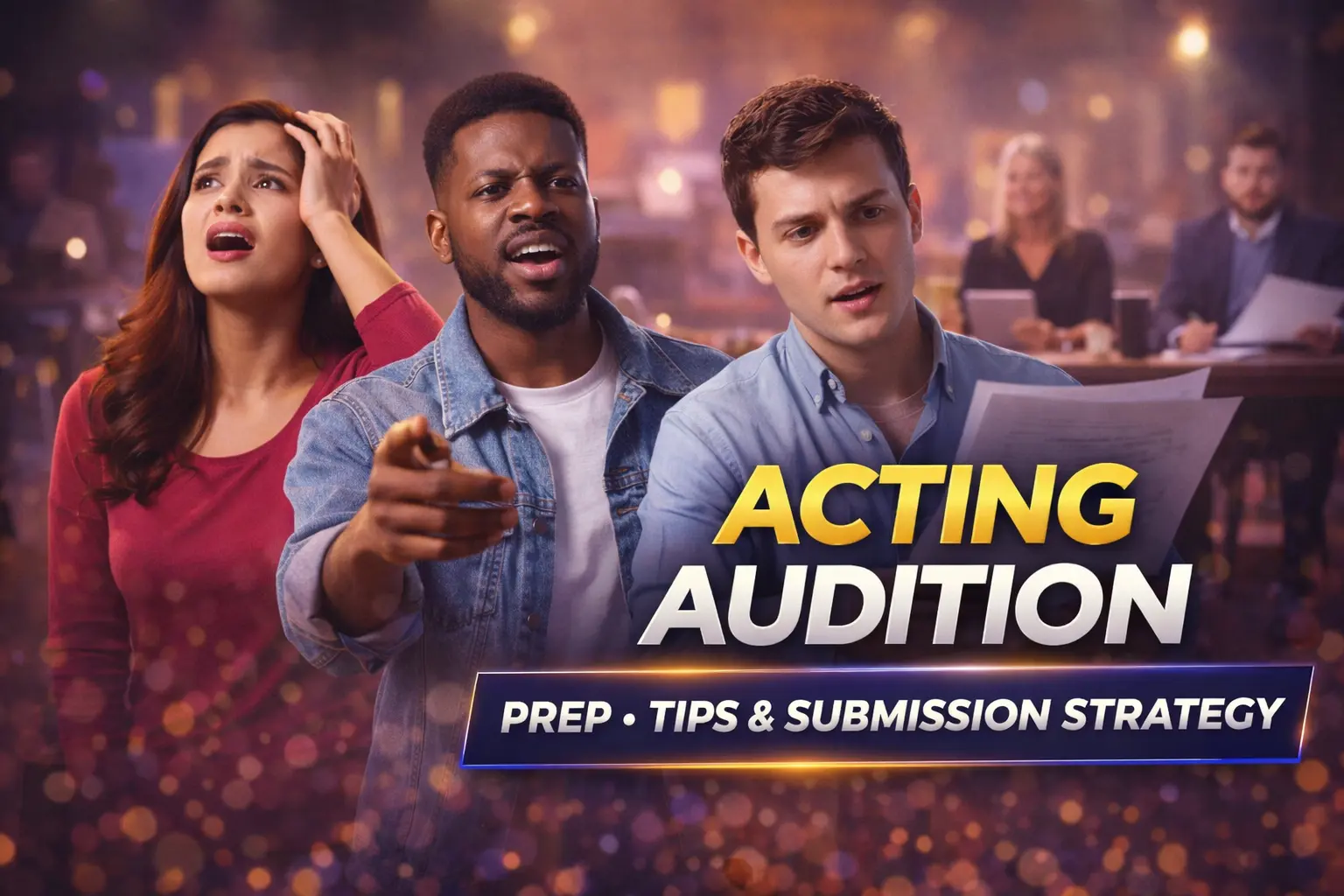
An acting audition is much more than a performance: it’s a short job interview, a marketing slice of your talent, and often your single chance to be seen by people who can hire you. Therefore, preparation must be precise, focused, and strategic. Below you’ll find practical steps, unique insider signals casting pros look for, technical checklists, and a short action plan that actually moves the needle.
Quick overview: What an acting audition really tests
An audition tests three things at once: skills, suitability, and reliability.
- First, casting checks your craft — voice, diction, timing.
- Next, they evaluate whether you match the role’s look, age and energy.
- Finally, they assess whether you’re easy to work with — punctuality, coachability and temperament.
Consequently, your job is to present all three clearly and quickly.
Unique insider signals casting directors notice (most guides skip these)
- Micro-choices matter. A tiny vocal or physical detail — for example, a way you chew a line — signals specificity. Casting favors actors who make distinct choices.
- Dust-free slate. If your slate (name/role intro) is crisp, confident and under 3 seconds, it signals professionalism. Producers notice that more than you realize.
- Change velocity. When asked for direction, show immediate, clear changes. Slow or tentative changes hurt your chance more than the initial read.
- Audition metadata. For self-tapes, filename + description + transcript are scanned by assistants. So, label files professionally and paste a short transcript in the submission form.
- Retention on clips. If you submit via platforms that record view time, shorter clips that retain the reader/viewer have higher chance of being forwarded to producers.
Because these signals are subtle, train to show them every time.
Self-tape: technical checklist (exact settings that work)
- Camera: 1080p (H.264). Higher is fine, but compress gently.
- Audio: 44.1kHz or 48kHz WAV/MP3; aim for 96–192 kbps if MP3. Use a small condenser or lavalier placed just off camera.
- Lighting: two-point lighting — soft key + fill; avoid window backlight.
- Frame: medium close-up (head + upper chest); use 16:9 landscape orientation.
- Background: plain, neutral, non-distracting.
- File name:
lastname_firstname_project_role_yyMMdd.mp4. - Transcript: paste 2–3 sentence transcript into the submission form. It helps assistants search and AI agents index your clip.
In addition, always export with a small .srt subtitle file — it increases accessibility and view retention.
Performance checklist: what to rehearse that actually helps
- Hook first. Lead with the strongest emotional or musical moment in the first 10–15 seconds.
- One big choice. Choose one clear tactic (e.g., ironic, desperate, resigned) and stick with it.
- Active listening. Even when you perform alone, imagine the other person and react — it makes you alive.
- Breath punctuation. Use breaths as punctuation; they can sell choices better than extra words.
- Controlled vulnerability. Show the moment people can’t look away from; then contain it.
These rehearsal priorities beat endless technical runs.
Smart audition submission strategy (how to get noticed)
- First, diversify. Apply to 10-15 appropriate roles per month rather than obsessing on one.
- Second, optimize metadata. Attach a one-line logline to your submission: role + short character descriptor + 1 key credit.
- Third, follow up correctly. Send a brief thank-you email 24–48 hours after a live audition; for self-tapes, only follow up if requested.
- Fourth, track metrics. Keep a spreadsheet: role, date submitted, file name, platform, and any feedback; over time patterns appear (which types of roles you get callbacks for).
Legal & rights checklist (what to sign and what to avoid)
- Read exclusivity clauses. Never sign long exclusivity without compensation.
- Original material: if you perform originals, keep dated files and stems.
- Usage rights: clarify whether the show obtains master rights to your audition or performance.
- Minors: parents/guardians should confirm payment and travel details in writing.
Protect your work before you hand over final masters or agree to distribution.
30-day action plan to book more roles (compact & practical)
- Days 1–7: Prepare two contrasting monologues; record high-quality self-tapes.
- Days 8–14: Apply to 10 appropriate auditions; post one trimmed audition clip to social media.
- Days 15–21: Take a coaching session focused on “change on direction” and record the new read.
- Days 22–28: Submit again to 10 more roles; optimize metadata and transcript.
- Day 29–30: Review metrics and feedback; refine your loader (hook) for next month.
Repeat monthly — volume + quality = bookings.
Quick PAA (People Also Ask)
Q: How long should an acting audition self-tape be?
A: Follow the brief, but generally 60–120 seconds for auditions; include a 2–3 second slate at top.
Q: What camera settings are best for self-tapes?
A: Use 1080p H.264 with 44.1/48kHz audio. Keep the bitrate moderate (8–12 Mbps) to balance quality and upload speed.
Q: Should I memorize or read sides?
A: Memorize where possible. However, be comfortable cold-reading: ability to react to new text is often tested.
Final takeaway — audition like a professional, not a hopeful
An acting audition won’t be won by luck. Instead, win it by being precise, coachable, and searchable. In short, present a clear choice, deliver clean technical files, and manage your submissions like a campaign. Above all, remain a calm, adaptable collaborator — that combination makes casting directors want to work with you again.